

Triangular Fibrocartilage Complex (TFCC) Injuries Treatment in Raleigh, NC
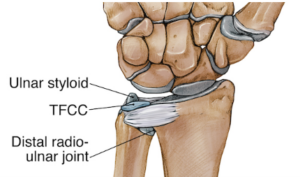
What is the TFCC?
The triangular fibrocartilage complex (TFCC) is a crucial structure on the ulnar (pinky finger) side of your wrist. It acts as a cushion between the small bones of the wrist and the ulna bone of the forearm, while also stabilizing the wrist joint during rotation movements. The TFCC is made up of several components including cartilage, ligaments, and supportive tissues that work together to allow smooth wrist motion and distribute forces across the wrist.
Causes of Wrist Sprain or TFCC Injuries
TFCC injuries can occur from:
– Acute trauma: The most common cause is falling forward onto an outstretched hand with the wrist in a pronated (palm-down) position
– Repetitive stress: Activities involving repeated twisting motions or axial loading on the ulnar side of the wrist, such as swinging a baseball bat, performing gymnastics, or using tools like hammers and screwdrivers
– Occupational activities: Manual labor that stresses the wrist, such as carpentry or plumbing work
– Degenerative changes: Wear and tear over time, especially in individuals over 50 years old
Symptoms
Common symptoms of TFCC injuries include:
– Pain on the ulnar (pinky) side of the wrist
– Pain that worsens with gripping, twisting motions, or weight-bearing on the hand
– Clicking or popping sensation in the wrist
– Decreased grip strength
– Swelling on the ulnar side of the wrist
– Limited range of motion, especially with forearm rotation
– Instability or feeling that the wrist is “giving way”
Diagnosis
Your healthcare provider will diagnose a TFCC injury through:
– Physical examination: Specific tests including the ulnar fovea sign (tenderness over a specific area), ulnocarpal stress test, and assessment of wrist stability
– Imaging studies:
– X-rays to rule out fractures and assess bone alignment
– MRI (magnetic resonance imaging) with high sensitivity and specificity for detecting TFCC tears
– Wrist arthroscopy (camera examination of the joint) remains the gold standard for definitive diagnosis
Treatment Options for Wrist Sprain or TFCC Injuries
Conservative (Non-Surgical) Treatment
Initial treatment for TFCC injuries typically includes:
– Immobilization: Splinting or casting for 4-6 weeks, with above-elbow immobilization showing better outcomes than short-arm splints
– Rest and activity modification: Avoiding activities that aggravate symptoms
– Anti-inflammatory medications: To reduce pain and swelling
– Physical therapy: Once acute pain subsides, to restore range of motion and strength
– Corticosteroid injections: For persistent pain in select cases
– Platelet-rich plasma (PRP) injections: May be considered for recalcitrant cases, though evidence is still evolving
Studies show that approximately 30% of patients achieve complete recovery at 6 months and 50% at one year with conservative treatment alone. A minimum of 6 months of non-surgical treatment is recommended as first-line therapy for TFCC tears without wrist instability.
Surgical Treatment
Surgery may be recommended if: Conservative treatment fails after 6 months; There is significant wrist instability; The injury involves complete tears at the foveal attachment; There is dorsal subluxation of the distal radioulnar joint
Surgical options include:
– Arthroscopic debridement: Removal of torn tissue for central tears (Palmer 1A)
– Arthroscopic repair: Suturing torn peripheral tissue back together for peripheral tears (Palmer 1B)
– Foveal reattachment: Reattaching the TFCC to its bone insertion site using sutures or anchors for tears causing instability
– Open repair: Direct surgical repair through an incision, typically reserved for complex cases with instability
Recovery and Outcomes
– Conservative treatment: Gradual return to activities over 3-6 months
– After arthroscopic debridement: Return to activities typically within 6-12 weeks
– After arthroscopic repair: Immobilization for 6 weeks followed by rehabilitation, with return to full activities at 3-6 months
– Success rates: Arthroscopic repair shows satisfactory outcomes in over 90% of patients for appropriate tear types
Factors Affecting Prognosis
Better outcomes are associated with: Above-elbow immobilization for conservative treatment; Absence of wrist instability; Early diagnosis and treatment; Compliance with rehabilitation protocols
Poorer outcomes may occur with: Presence of wrist instability; Positive ulnar variance (longer ulna bone); Concomitant injuries; Smoking
Prevention
To reduce the risk of TFCC injuries: Use proper technique during sports and work activities; Strengthen wrist and forearm muscles; Avoid repetitive forceful gripping and twisting when possible; Use protective equipment during high-risk activities; Address wrist pain early before it becomes chronic
Why Choose Dr. Chambers for Hand and Wrist Care
At Raleigh Orthopaedic Clinic, Dr. Stephen Chambers specializes in hand and upper extremity surgery. With years of expertise in treating hand and wrist injuries, including Wrist Sprain or TFCC Injuries, Dr. Chambers provides comprehensive care—ranging from at home treatments and injections to advanced hand surgery when needed. Patients trust Dr. Chambers and his team for personalized care, effective treatment options, and excellent outcomes and describe Dr. Chambers as a caring, attentive, and skilled surgeon with excellent bedside manner. His amazing team ensures every patient feels supported and informed throughout the process.
If you are experiencing finger pain, swelling, or difficulty with wrist movements, don’t wait for symptoms to worsen. Schedule an Appointment with Dr. Chambers today Wrist Sprain or TFCC Injuries, and get back to normal use of your hand . Experience the benefit of specialized hand care close to home at Raleigh Orthopaedics in Raleigh, Cary, Holly Springs, and Wake Forest, North Carolina.