

Fingernail Injury Treatment in Raleigh, NC
Overview
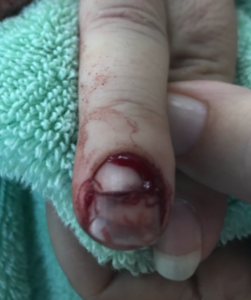
Fingernail injuries are among the most common hand injuries seen in emergency departments and primary care settings. These injuries typically result from crush trauma, sports activities, or accidental trauma and can range from simple subungual hematomas to complex nail bed lacerations with associated fractures. Prompt and appropriate treatment is essential to minimize long-term complications, preserve nail function and appearance, and restore normal hand function.
Types of Fingernail Injuries
Subungual Hematoma
A subungual hematoma occurs when blood collects beneath the nail plate following direct trauma to the fingertip. This condition is characterized by:
– Painful, throbbing sensation
– Visible dark discoloration under the nail
– Swelling of the affected finger
– Typically results from crush injuries
Nail Bed Laceration
Nail bed lacerations generally occur after crushing trauma and can be classified as:
– Simple lacerations: Clean, linear tears
– Complex lacerations: Irregular patterns with tissue damage
– Stellate lacerations: Star-shaped tears with multiple directions
These injuries often present with subungual bleeding and may be associated with distal phalanx fractures.
Associated Injuries
Fingernail injuries frequently occur with:Distal phalanx (tuft) fractures;Distal interphalangeal (DIP) joint dislocations; Soft tissue injuries to the fingertip; Tendon injuries (mallet finger, jersey finger)
Treatment in Raleigh, NC
Subungual Hematoma
Conservative Management:
– Small, non-painful hematomas: Observation, ice application, and elevation
– No nail removal required for intact nail plates
Nail Trephination:
– Indicated for painful or enlarging hematomas
– Creates a small hole in the nail plate to drain blood and relieve pressure
– Methods include:Heated paper clip (traditional method); Specialized trephination tools; Handheld portable cautery; Extra-fine needle (29-gauge insulin syringe)
– Results in immediate pain relief
– Studies show no difference in nail deformity outcomes compared to nail removal and repair
When to Consider Nail Removal: Disruption of the nail plate;Injury to surrounding nail folds; Associated complex fractures requiring stabilization
Nail Bed Laceration
Current Evidence:
Recent studies indicate no significant difference in cosmetic outcomes between nail bed repair and conservative management without nail removal. Treatment options include:
Conservative Management:Observation and reassurance for many cases; Appropriate when nail plate remains intact;Wound care and monitoring for infection
Distal Phalanx Fractures
Non-operative Management:
– Simple, closed, minimally displaced fractures
– Splint stabilization for 3-4 weeks
– Prophylactic antibiotics NOT recommended
Operative Management:
– Complex fractures (notably angulated or displaced)
– Unstable fractures
– Open fractures
– Intra-articular fractures involving >1/3 of articular surface
Wound Care and Follow-up
Immediate Care:
– Tetanus prophylaxis if >5 years since last dose for contaminated wounds
– Pain management with oral analgesics
– Elevation and ice application
Patient Education:
– Full nail regrowth takes approximately 6 months
– Keep wound clean and dry
– Watch for signs of infection (increased pain, redness, drainage, fever)
– Avoid premature removal of splints or dressings
FComplications and Prevention
Potential Complications
– Nail deformity or dystrophy; Chronic pain; Infection (osteomyelitis if bone involved);Loss of nail function; Reduced fingertip sensation
Summary
Fingernail injuries are common and can be effectively managed in primary care settings with appropriate evaluation and treatment. Conservative management with nail trephination for subungual hematomas and observation for many nail bed lacerations yields excellent outcomes. Radiographic evaluation is essential to identify associated fractures. Complex injuries, unstable fractures, and tendon injuries require referral to hand surgery specialists. With proper management, most patients achieve good functional and cosmetic outcomes.
Request an appointment with our hand specialist in Raleigh, NC.
Why Choose Dr. Chambers for Hand and Wrist Care
At Raleigh Orthopaedic Clinic, Dr. Stephen Chambers specializes in hand and upper extremity surgery. With years of expertise in treating hand and wrist injuries, including Finger Nail Injury. Dr. Chambers provides comprehensive care—ranging from at home treatments and injections to advanced hand surgery when needed. Patients trust Dr. Chambers and his team for personalized care, effective treatment options, and excellent outcomes and describe Dr. Chambers as a caring, attentive, and skilled surgeon with excellent bedside manner. His amazing team ensures every patient feels supported and informed throughout the process.
If you are experiencing finger pain, swelling, or difficulty with finger movements, don’t wait for symptoms to worsen. Schedule an Appointment with Dr. Chambers today to Finger Nail Injury and get back to normal use of your hand . Experience the benefit of specialized hand care close to home at Raleigh Orthopaedics in Raleigh, Cary, Holly Springs, and Wake Forest, North Carolina.