
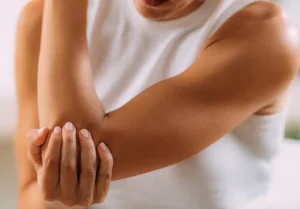
What is Little League Elbow?
Little League elbow, also known as medial epicondyle apophysitis, is an overuse injury affecting the growth plate on the inner side of the elbow in young baseball players, typically between ages 9 and 13.The condition results from repetitive valgus stress during throwing, causing microtrauma to the medial elbow, particularly during the late cocking and early acceleration phases of pitching.[1]
Conservative Treatment (First-Line Approach)
Complete rest from throwing for 4-6 weeks is the cornerstone of treatment for Little League elbow, with most athletes returning to competitive throwing after approximately 3 months.The American College of Sports Medicine recommends nonoperative management with activity modification, rehabilitation, addressing kinetic chain deficits, and modification of throwing demands.[2]
Key Components of Conservative Management:
Rest and Activity Modification
– Complete cessation of throwing activities for 4-6 weeks
– Athletes may maintain other physical activities during this period[1]
– Avoid corticosteroid injections, which should not be used in this region[2][3]
Physical Therapy and Rehabilitation
The rehabilitation program should address:[2]
– Core strengthening and scapular stabilization
– Range of motion exercises for shoulder with protected elbow movement
– Strengthening exercises for shoulder and elbow
– Evaluation and correction of throwing mechanics
– Assessment of kinetic chain deficits (core weakness, lower-extremity strength imbalances)
Gradual Return to Throwing Protocol
Athletes should complete a structured return-to-sport (RTS) program only after full resolution of symptoms.[2] The throwing program should be position-specific and gradually progressive.[2][3]
When Surgery May Be Considered
Medial epicondyle apophysitis itself is treated nonoperatively; however, surgical intervention may be indicated for specific complications:[2]
– Medial epicondyle avulsion fractures with significant displacement may require operative fixation[2]
– Complete UCL tears or failure of extensive conservative management after partial UCL tears[4]
– Unstable osteochondritis dissecans (OCD) lesions of the capitellum or failed nonoperative treatment[2]
For UCL injuries requiring surgery, reconstruction remains the gold standard with return-to-play rates of 80-90%, though return to competition typically takes 12-16 months.[2][4]
Prevention Strategies
Prevention is critical for young throwing athletes and includes:[1][2]
Pitch Count Management
– Follow Major League Baseball Pitch Smart guidelines organized by age group[1]
– Manage medial elbow loading through appropriate pitch counts[2]
– Monitor season length, number of teams, and tournament frequency[2]

Annual Rest Requirements
– At least 4 months of rest from overhead throwing annually[1]
– Include at least 2 continuous months of rest[1]
Biomechanical and Strength Training
– Assess throwing biomechanics to ensure proper technique[1]
– Core muscle strengthening (abdominals, quadriceps)[1]
– Stretching programs to increase shoulder and thoracic mobility[1]
– Address lower-extremity strength deficits and imbalances[2]
Education
– Work with athletic care networks to educate athletes, parents, and coaches on injury prevention[2]
– Avoid playing through pain or fatigue[2]
Timeline for Return to Sport
| Phase | Timeline | Key Milestones | References |
|---|---|---|---|
| Initial Rest | 4-6 weeks | Complete cessation of throwing; maintain other activities | [1] |
| Rehabilitation | 6-12 weeks | Physical therapy, biomechanical assessment, gradual strengthening | [2] |
| Return to Throwing | 3 months | Structured throwing protocol, position-specific training | [1], [2] |
| Return to Competition | 3 months | Full resolution of symptoms, completion of RTS program | [1], [2] |
Pain Management
For acute pain control during the initial treatment phase:[3]
– Acetaminophen and low-dose, short-term NSAIDs as needed (do not have detrimental effects on healing)
– Opioids should be used sparingly if at all
– Early protected range of motion is encouraged to avoid residual stiffness
Prognosis
With appropriate conservative management, the prognosis for Little League elbow is excellent. Most young athletes can successfully return to competitive throwing after 3 months when following a structured rehabilitation and return-to-throwing protocol.The key to successful outcomes is adherence to rest periods, proper rehabilitation addressing kinetic chain deficits, and prevention strategies including pitch count management and annual rest requirements.
Why Choose Dr. Chambers for Hand and Elbow Care
At Raleigh Orthopaedic Clinic, Dr. Stephen Chambers specializes in hand and upper extremity surgery. With years of expertise in treating hand and elbow injuries, including Little League Elbow Treatment. Dr. Chambers provides comprehensive care—ranging from at home treatments and injections to advanced hand surgery when needed. Patients trust Dr. Chambers and his team for personalized care, effective treatment options, and excellent outcomes and describe Dr. Chambers as a caring, attentive, and skilled surgeon with excellent bedside manner. His amazing team ensures every patient feels supported and informed throughout the process.
If you are experiencing elbow pain, swelling, or difficulty with wrist movements, don’t wait for symptoms to worsen. Schedule an Appointment with Dr. Chambers today to Little League Elbow Treatment. and get back to normal use of your hand . Experience the benefit of specialized hand care close to home at Raleigh Orthopaedics in Raleigh, Cary, Holly Springs, and Wake Forest, North Carolina.
