

Thumb Ligament Injury Treatment in Raleigh, NC
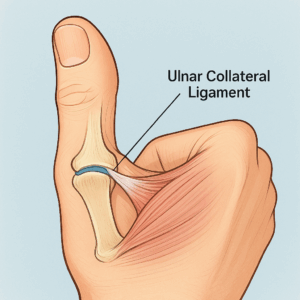
What is Thumb UCL Injury?
Thumb ulnar collateral ligament (UCL) injury, also known as “skier’s thumb” or “gamekeeper’s thumb,” is a common hand injury affecting the ligament on the inner side of the thumb at the metacarpophalangeal (MCP) joint. This injury can cause pain, instability, and weakness during pinching and grasping activities. If left untreated, it may lead to chronic instability, decreased hand function, and arthritis.
Causes and Risk Factors
Thumb UCL injuries typically occur when the thumb is forcefully bent away from the hand (radial deviation). Common causes include:
– Skiing accidents – falling with a ski pole in hand
– Sports injuries – football, basketball, volleyball
– Falls – landing on an outstretched thumb
– Direct trauma to the thumb
Symptoms
Patients with thumb UCL injury may experience: Pain and tenderness along the inner aspect of the thumb; Swelling and bruising at the MCP joint; Weakness with pinching and gripping; Instability or “looseness” of the thumb joint; Difficulty with activities requiring thumb strength
Diagnosis
Clinical Examination
Diagnosis is primarily based on physical examination, including stability testing of the thumb MCP joint. Your physician will compare the injured thumb to the uninjured side and assess for excessive joint laxity.
Imaging Studies
– X-rays – to identify fractures or bone avulsion
– Stress radiographs – to assess joint stability
– MRI – to distinguish partial from complete tears and identify Stener lesions
– Ultrasound – can detect ligament tears and displacement
A Stener lesion occurs when the torn ligament becomes trapped outside the adductor aponeurosis, preventing natural healing. This finding typically requires surgical intervention.
Treatment Options
Non-Surgical Treatment
Indications:
– Partial UCL tears without significant instability
– Minimal ligament displacement (less than 3 mm)
– No Stener lesion present
Protocol:
– Immobilization with a thumb spica cast or splint for 4-6 weeks
– The cast includes the MCP and carpometacarpal (CMC) joints in a neutral position
– Gradual return to activities after immobilization
– Hand therapy for strengthening and range of motion
Success Rates:
Partial and minimally displaced tears typically heal well with immobilization alone. However, tears with more than 3 mm displacement have a 90% failure rate with conservative treatment.
Surgical Treatment
Indications:
– Complete UCL rupture with significant joint laxity (>30° radial deviation or >20° difference compared to uninjured side)
– Stener lesion present
– Displaced avulsion fractures
– Failed conservative treatment
– Ligament displacement greater than 3 mm on MRI
Acute Repair (within 2-3 weeks):
Primary surgical repair involves reattaching the torn ligament to its insertion point using various techniques: Bone anchor reinsertion; Suture fixation; K-wire fixation; Combination techniques; Suture tape augmentation (newer technique with excellent short-term results)
All surgical techniques demonstrate excellent clinical outcomes with no significant differences between methods.
Chronic Reconstruction (delayed presentation):
For chronic injuries or failed repairs, ligament reconstruction using tendon grafts may be necessary. Both static and dynamic reconstruction techniques yield excellent results.
Postoperative Care:
Immobilization for 4 weeks with non-removable cast; Removable cast for additional 4 weeks; Controlled active range of motion exercises starting at 3-4 weeks; Protective splinting continued until 6 weeks; Unrestricted use typically allowed at 12 weeks
Treatment Outcomes
Surgical Outcomes
– Excellent clinical results in most patients
– Preservation of motion, key pinch, and grip strength
– Low complication rates
– Return to full activities in 3-4 months
– No significant difference between acute repair and chronic reconstruction outcomes
Current Guidelines and Recommendations
According to the 2024 British Society for Surgery of the Hand guidelines:
All acute UCL injuries should be assessed with history, clinical examination, and radiographs. Patients without significant joint laxity can be treated non-surgically. Patients with significant joint laxity may choose between non-surgical immobilization or surgical repair through shared decision-making with their clinician. Treatment decisions should be made within 2 weeks of presentation
Prevention
To reduce the risk of thumb UCL injury: Use proper technique when skiing (learn to release poles during falls). Wear protective equipment during contact sports. Strengthen thumb and hand muscles. Avoid activities that place excessive stress on the thumb when fatigued
Prognosis
With appropriate treatment, most patients achieve excellent functional outcomes. Early diagnosis and treatment are essential to prevent chronic instability and arthritis. Both surgical repair and reconstruction demonstrate high success rates with proper patient selection and technique.
What is Skier’s Thumb?
Skier’s Thumb is a tear of the ulnar collateral ligament (UCL) in the thumb, usually caused by a fall onto an outstretched hand.
Do all UCL tears require surgery?
No. Partial tears often heal with splinting. Complete tears or instability typically require surgical repair.
How long does recovery take?
Most patients recover in 6–12 weeks depending on tear severity and treatment.
Why Choose Dr. Chambers for Hand and Wrist Care
At Raleigh Orthopaedic Clinic, Dr. Stephen Chambers specializes in hand and upper extremity surgery. With years of expertise in treating hand and wrist injuries, including Thumb Ligament (UCL) Treatment. Dr. Chambers provides comprehensive care—ranging from at home treatments and injections to advanced hand surgery when needed. Patients trust Dr. Chambers and his team for personalized care, effective treatment options, and excellent outcomes and describe Dr. Chambers as a caring, attentive, and skilled surgeon with excellent bedside manner. His amazing team ensures every patient feels supported and informed throughout the process.
If you are experiencing finger pain, swelling, or difficulty with finger movements, don’t wait for symptoms to worsen. Schedule an Appointment with Dr. Chambers today to Thumb Ligament (UCL) Treatment. and get back to normal use of your hand . Experience the benefit of specialized hand care close to home at Raleigh Orthopaedics in Raleigh, Cary, Holly Springs, and Wake Forest, North Carolina.