

Endoscopic Carpal Tunnel Release, Raleigh, NC
What is Endoscopic Carpal Tunnel Release?
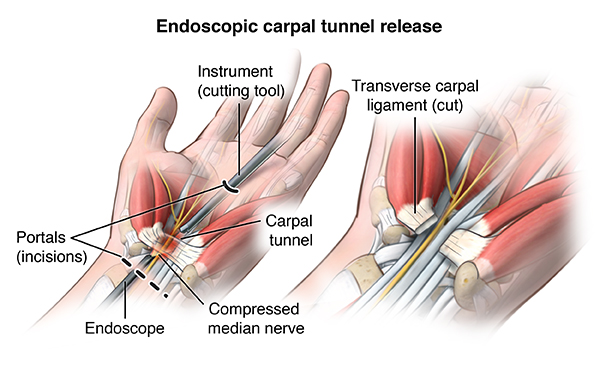
Endoscopic carpal tunnel release (ECTR) is a minimally invasive surgical technique for treating carpal tunnel syndrome by releasing pressure on the median nerve through transection of the transverse carpal ligament. The procedure utilizes specialized endoscopic equipment through one or two small portals, allowing visualization and division of the ligament without the larger incision required in traditional open surgery.
Surgical Technique
ECTR can be performed using either single-portal or two-portal techniques, with both antegrade and retrograde designs available. The procedure involves inserting an endoscope through a small transverse incision proximal to the wrist crease, allowing the surgeon to visualize the transverse carpal ligament and divide it under direct endoscopic visualization. The minimally invasive approach preserves the palmar fascia and subcutaneous tissue while achieving complete ligament release.
Clinical Outcomes
Symptom Relief and Functional Recovery
Long-term outcomes between ECTR and open carpal tunnel release (OCTR) show no significant differences in symptom improvement or functional status. Meta-analyses demonstrate equivalent results at 6 months postoperatively for pain relief, digital sensation, and functional status indices including Boston Carpal Tunnel Questionnaire scores.
In the short term (within 3 months), ECTR offers several advantages:Greater pinch strength and hand dexterity compared to open release; Superior improvement in sleep symptoms; Higher patient satisfaction scores; Faster return to work by approximately 8 days on average
Patient Satisfaction
Multiple studies demonstrate higher patient satisfaction with ECTR compared to open techniques. In bilateral carpal tunnel syndrome studies where patients received both techniques (one in each hand), patients consistently preferred the endoscopic approach despite similar functional outcomes.
Complications and Safety Profile
Short-Term Complications
ECTR has a higher rate of short-term complications compared to OCTR (1.63% vs 0.79%), predominantly consisting of transient median neurapraxia. Transient nerve injury occurs in 1.45% of ECTR patients versus 0.25% with open release. However, these nerve complications are typically temporary and resolve without surgical intervention.
Wound and Scar Complications
ECTR demonstrates significantly fewer wound and scar-related complications compared to open surgery (0.1% vs 1.3%). This translates to an 80% reduction in scar-related issues including infection, hypertrophic scarring, and scar tenderness.
Major Complications
Major complications including permanent structural injuries, complex regional pain syndrome, and moderate to severe pain beyond 12 months occur infrequently (0.9% of patients) with no significant differences between ECTR and OCTR. Permanent nerve injury rates are comparable between techniques.
Revision Surgery
Symptoms persist or recur in 3-20% of patients regardless of surgical technique, with revision surgery required in up to 12% of cases. Re-operation rates show no significant difference between ECTR and OCTR, though recent long-term data suggests ECTR may have a modestly higher revision rate over 15 years.
Advantages of Endoscopic Approach
– Smaller incision with better cosmetic results; Reduced scar tenderness and wound complications; Faster postoperative recovery; Earlier return to work (approximately 1 week sooner); Higher patient satisfaction; Improved short-term grip strength and pinch strength
Limitations and Considerations
Technical Challenges
The endoscopic approach has limited visualization of the surgical field, which may result in:Potential for incomplete ligament release; Difficulty identifying anatomic variations; Inability to detect aberrant superficial palmar arch; Missed diagnosis of tenosynovitis or masses in the carpal tunnel
Clinical Practice Guidelines
The American Academy of Orthopaedic Surgeons states there is limited evidence that practitioners might consider using ECTR based on short-term benefits including faster motor function recovery, earlier return to work, and lower wound complication rates. However, strong evidence suggests no difference in long-term patient-reported outcomes between mini-open and endoscopic techniques.
The European HANDGUIDE guidelines recommend open surgery using a longitudinal, non-extended incision as the preferred approach.
Indications
ECTR is appropriate for patients with carpal tunnel syndrome who:Require surgical decompression; Desire faster return to work or activities; Are concerned about scar appearance or pillar pain; Have failed conservative management
Relative Contraindications
Situations where open surgery may be preferred include:Suspected anatomic variations requiring direct visualization; Presence of masses or tenosynovitis requiring exploration;Revision surgery with significant scarring
Summary
Endoscopic carpal tunnel release is an effective, safe alternative to open carpal tunnel release with equivalent long-term outcomes. The technique offers advantages in short-term recovery, return to work, and wound complications, though it carries a slightly higher risk of transient nerve injury. Patient preference, surgeon experience, and individual clinical factors should guide the choice between endoscopic and open approaches.
Why Choose Dr. Chambers for Hand and Wrist Care
At Raleigh Orthopaedic Clinic, Dr. Stephen Chambers specializes in hand and upper extremity surgery. With years of expertise in treating hand and wrist injuries, including Endoscopic Carpal Tunnel Release Treatment. Dr. Chambers provides comprehensive care—ranging from at home treatments and injections to advanced hand surgery when needed. Patients trust Dr. Chambers and his team for personalized care, effective treatment options, and excellent outcomes and describe Dr. Chambers as a caring, attentive, and skilled surgeon with excellent bedside manner. His amazing team ensures every patient feels supported and informed throughout the process.
If you are experiencing hand pain, swelling, or difficulty with wrist movements, don’t wait for symptoms to worsen. Schedule an Appointment with Dr. Chambers today to Endoscopic Carpal Tunnel Release Treatment and get back to normal use of your hand . Experience the benefit of specialized hand care close to home at Raleigh Orthopaedics in Raleigh, Cary, Holly Springs, and Wake Forest, North Carolina.