

Golfer's Epicondylitis (Medial Epicondylitis) Treatment in Raleigh, NC
Understanding Golfer’s Epicondylitis
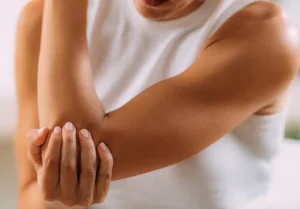
Golfer’s epicondylitis, also known as medial epicondylitis or “golfer’s elbow,” is a condition affecting the tendons on the inside of your elbow. Despite its name, you don’t have to play golf to develop this condition. It occurs when the tendons that attach to the bony bump on the inside of your elbow (medial epicondyle) become damaged from repetitive stress.
What Causes Golfer’s Epicondylitis?
This condition develops from repetitive wrist flexion (bending your wrist forward) and forearm rotation movements. Common causes include:
– Sports activities: Golf, baseball (especially pitching), tennis, weightlifting, and racquet sports
– Occupational activities: Carpentry, plumbing, painting, typing, and other jobs requiring repetitive hand and wrist movements
– Daily activities: Gardening, using hand tools, or any repetitive gripping activities
The condition involves degeneration of the flexor-pronator tendons rather than inflammation, which is why it may take time to heal.
Symptoms to Watch For
– Pain and tenderness on the inside of your elbow
– Pain that worsens with wrist flexion or gripping activities
– Weakness in your hand and wrist
– Stiffness in the elbow
– Pain that may radiate down your forearm
– Numbness or tingling in your fingers (especially the ring and little fingers) if the ulnar nerve is affected
Treatment Options
First-Line Conservative Treatment
Most cases of golfer’s epicondylitis improve with conservative treatment over 6-12 months:
Rest and Activity Modification
– Avoid or modify activities that trigger your pain
– Take breaks during repetitive activities
– Use proper technique in sports and work activities
Ice Therapy
– Apply ice for 15-20 minutes several times daily, especially after activities
– Use a barrier between ice and skin to prevent frostbite
Over-the-Counter Pain Relief
– Acetaminophen or NSAIDs (like ibuprofen) can help manage pain
– Use the lowest effective dose for the shortest time needed
Physical Therapy
– Stretching exercises for your forearm muscles
– Strengthening exercises, particularly eccentric exercises (controlled lengthening of muscles)
– Deep tissue massage
– Ultrasound therapy may provide benefit
Bracing
– Counterforce bracing (a strap worn on the forearm) may help reduce stress on the tendon
– Wrist splints during activities or at night
Advanced Treatment Options
If symptoms persist after 3-6 months of conservative treatment, your doctor may discuss:
Corticosteroid Injections
– Provide short-term pain relief (up to 6-8 weeks)
– May have worse long-term outcomes compared to other treatments
– Risk of skin changes and tendon weakening with repeated injections
– Generally not recommended as a first-line treatment
Platelet-Rich Plasma (PRP) Injections
– Uses your own blood components to promote healing
– May provide better long-term pain relief than corticosteroid injections
– Requires one or more injections over several weeks
Ultrasound-Guided Percutaneous Tenotomy
– Minimally invasive procedure using ultrasound guidance
– Removes damaged tendon tissue through a small needle
– Similar outcomes to PRP injections
Extracorporeal Shockwave Therapy
– Non-invasive treatment using sound waves
– May help stimulate healing in chronic cases
Surgical Treatment
Surgery is rarely needed but may be considered if:
– Symptoms persist despite 6-12 months of appropriate conservative treatment
– Pain significantly affects your daily activities or work
– Imaging shows significant tendon damage
Surgical options include:
– Open surgery: Removal of damaged tendon tissue and repair of the tendon origin
Recovery Timeline
– Conservative treatment: Most people improve within 6-12 months
– After injections: Gradual improvement over several weeks to months
– After surgery: Return to light activities in 6-8 weeks; full recovery in 3-6 months
Prevention Tips
– Warm up properly before sports or physical activities
– Use proper technique in sports and work activities
– Strengthen your forearm muscles
– Take regular breaks during repetitive activities
– Use ergonomic equipment when possible
– Gradually increase intensity of new activities
When to Contact Your Doctor
– Pain persists despite 6-8 weeks of conservative treatment
– Severe pain that interferes with daily activities
– Numbness or tingling in your fingers
– Weakness in your hand or wrist
– Inability to perform work or daily activities
Important Reminders
– Golfer’s epicondylitis is a degenerative condition, not an inflammatory one, which is why healing takes time
– There is no evidence that using your elbow despite pain causes additional harm, though you should avoid activities that cause severe pain
– Be patient with treatment—most cases resolve without surgery
– Continuing gentle movement and gradually returning to activities is important for recovery
Why Choose Dr. Chambers for Elbow Care
At Raleigh Orthopaedic Clinic, Dr. Stephen Chambers specializes in hand and upper extremity surgery. With years of expertise in treating hand and wrist injuries, including Golfer’s Elbow, Dr. Chambers provides comprehensive care—ranging from at home treatments and injections to advanced hand surgery when needed. Patients trust Dr. Chambers and his team for personalized care, effective treatment options, and excellent outcomes and describe Dr. Chambers as a caring, attentive, and skilled surgeon with excellent bedside manner. His amazing team ensures every patient feels supported and informed throughout the process.
If you are experiencing finger pain, swelling, or difficulty with wrist movements, don’t wait for symptoms to worsen. Schedule an Appointment with Dr. Chambers today Golfer’s Elbow, and get back to normal use of your hand . Experience the benefit of specialized hand care close to home at Raleigh Orthopaedics in Raleigh, Cary, Holly Springs, and Wake Forest, North Carolina.