
Wrist Ganglion Cyst Treatment in Raleigh, NC
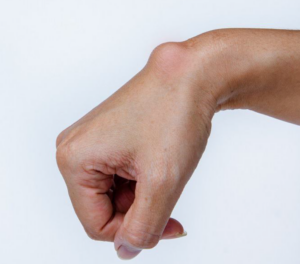
Noticed a firm, rounded lump on the back or palm side of your wrist? A wrist ganglion cyst is the most common soft-tissue mass in the hand — benign, not cancerous, and very treatable. Many resolve on their own.
What Is Wrist Ganglion Cyst?
A ganglion cyst is a fluid-filled sac arising from a joint capsule or tendon sheath. The fluid inside is thick and gelatinous — similar to joint fluid. Wrist ganglions most commonly arise from the scapholunate ligament on the back of the wrist (dorsal ganglion), or from the scaphotrapezial joint on the palm side (volar ganglion). Volar ganglions sit close to the radial artery and require careful surgical technique.
Occult (hidden) ganglions — too small to see or feel — are an important cause of wrist pain that can only be detected on MRI. They are completely benign but can cause significant wrist pain in certain positions.
ⓘ Not all wrist lumps are ganglions. Other possibilities include giant cell tumors of the tendon sheath, lipomas, and rarely, bone tumors. Any new wrist lump should be evaluated by a specialist to confirm the diagnosis before treatment.
Risk Factors
Several factors increase the likelihood of developing this condition.
Women 20–40
Most common demographic
Prior Wrist Injury
Ligament sprain or microtrauma
Active Wrist Use
Gymnastics, yoga, racquet sports
Wrist OA
Arthritis can generate ganglion-like cysts
Repetitive Motion
Repeated wrist extension activities
Joint Laxity
Hypermobile joints more prone
Stages of Wrist Ganglion Cyst
Cyst present but causes no pain or functional limitation. Observation appropriate.
Cyst causing wrist pain, aching, or pressure on adjacent structures.
Hidden ganglion causing wrist pain without visible lump, or cyst has recurred.
Diagnosis
Wrist ganglions are diagnosed clinically and confirmed with transillumination. MRI is used for occult ganglions or when the diagnosis is uncertain. The relationship of volar ganglions to the radial artery is assessed with Allen's test and sometimes ultrasound before surgery.
- ✓Physical exam and transillumination
- ✓Allen's test (volar ganglions — assess radial artery)
- ✓MRI for occult ganglion or uncertain diagnosis
- ✓Ultrasound to map relationship to radial artery
- ✓X-rays to assess underlying wrist arthritis
Treatment Outcomes & Statistics
Published outcome data to help you make an informed decision.
Many wrist ganglions resolve without any treatment
High recurrence without stalk removal
Excision with complete stalk removal — very low recurrence
High satisfaction after surgical excision
Complication Profile
| Complication | Rate | Severity | Notes |
|---|---|---|---|
| Recurrence after aspiration | 40–80% | Moderate | Common — root cause not addressed |
| Radial artery injury (volar) | <1% | Rare/Serious | Prevented with careful surgical technique and Allen's test |
| Scar tenderness | 10% | Minor | Resolves over weeks with scar massage |
| Wrist stiffness | 5–10% | Minor | Addressed with hand therapy |
| Recurrence after surgery | <5% | Moderate | Very low when stalk completely removed |
Source: Dias et al., JBJS 2007; Rizzo et al., J Hand Surg 2004
Treatment Options
Dr. Chambers will recommend the best approach based on your severity, goals, and lifestyle.
Observation
Asymptomatic ganglions may simply be watched. Up to 25–50% resolve spontaneously. If the cyst is not causing pain or functional problems, no treatment is necessary.
Aspiration
The cyst is drained with a needle in the office. Provides immediate relief of pressure and discomfort. High recurrence rate (40–80%) without stalk removal, but a reasonable choice if surgery is to be avoided.
Excision (with Stalk Removal)
The cyst and its stalk connecting to the scapholunate ligament or joint are completely removed. Addressing the root cause gives a recurrence rate under 5%. Volar ganglions require careful technique around the radial artery.
What to Expect During Recovery
Wound Care
Small dressing. Keep incision clean and dry. Light use of hand permitted.
Suture Removal
Stitches removed at 10–14 days. Scar massage begins. Hand used for most light activities.
Return to Activity
Full return to most activities. Wrist therapy if stiffness. Return to sports and manual work.
Full Recovery
Scar matures. Full wrist strength and motion. Recurrence rate under 5%.
Frequently Asked Questions
No — wrist ganglions are completely benign. They are not cancerous and do not spread. The main concerns are discomfort, cosmetic appearance, and occasional wrist weakness. Never try to pop or crush a ganglion yourself — this can cause injury and rarely resolves the cyst permanently.
Possibly — up to 25–50% of wrist ganglions resolve spontaneously without treatment. This is particularly true in younger patients with dorsal ganglions. Observation for 6–12 months is entirely reasonable for asymptomatic cysts before considering treatment.
An occult ganglion is a small ganglion that is too small to see or feel but causes significant wrist pain — particularly with certain wrist positions. It is only detectable on MRI. Occult ganglions are an important but often missed cause of wrist pain in young, active patients.
Absolutely not. Volar wrist ganglions sit immediately adjacent to the radial artery — the main blood vessel supplying the hand. Needle aspiration of volar ganglions should only be performed by an experienced surgeon with knowledge of the radial artery's position. Even in experienced hands, this is a delicate procedure.
Wrist Lump Worrying You? Get It Checked.
Wrist ganglions are benign and very treatable. No referral needed — same-day appointments available.

Stephen Chambers, M.D.
Dual Board-Certified Hand & Upper Extremity Surgeon · Raleigh Orthopaedic