

Distal Radius Fracture Treatment in Raleigh, NC
Fell on an outstretched hand? The distal radius — the end of the forearm bone at the wrist — is the most commonly broken bone in the body. Prompt evaluation ensures it heals in proper alignment, preserving your wrist's long-term strength and motion.
What Is Distal Radius Fracture?
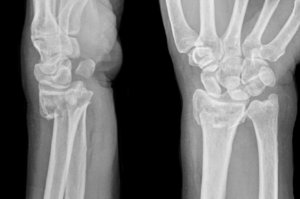
The distal radius is the end of the radius bone that forms the wrist joint. It is the most commonly fractured bone in the body, typically occurring when a person falls on an outstretched hand (FOOSH injury). The fracture can be simple and undisplaced, or complex with multiple fragments extending into the wrist joint.
Older adults with osteoporosis sustain these fractures with minimal trauma. Younger patients typically need higher-energy impacts. Proper alignment during healing is critical — the wrist joint surface must be restored to within 2mm of normal or arthritis develops prematurely.
ⓘ Get evaluated promptly. A distal radius fracture that heals in poor alignment causes lasting pain, stiffness, and early arthritis. Early reduction and proper immobilization or surgery prevents this.
Risk Factors
Several factors increase the likelihood of developing this condition.
Fall on Outstretched Hand
Most common mechanism — FOOSH
Osteoporosis
Low bone density — fracture with minimal force
Age 60+
Peak osteoporotic fracture age
Snowboarding
Wrist guards recommended but common injury
Cycling
Handlebars and falls
Children
Growth plate fractures — special considerations
Stages of Distal Radius Fracture
Bone broken but well aligned. Cast immobilization is sufficient.
Bone out of alignment — can be reduced (straightened) under local anesthesia and held in cast.
Fracture extends into wrist joint, multiple fragments, or cannot hold alignment in cast.
Diagnosis
Distal radius fractures are diagnosed with X-rays in multiple views. CT scan is used for complex articular fractures to fully map the fragments before surgery. Key measurements assessed: radial height, radial inclination, volar tilt, and ulnar variance — all critical for predicting outcomes.
- ✓X-rays (PA, lateral, oblique)
- ✓CT scan for complex articular fractures
- ✓Radial height, inclination, and volar tilt measurements
- ✓Neurovascular assessment (acute carpal tunnel possible)
- ✓Evaluation of the distal radioulnar joint (DRUJ)
Treatment Outcomes & Statistics
Published outcome data to help you make an informed decision.
Well-aligned fractures heal excellently with appropriate casting
Long-term outcomes with properly aligned fractures in cast
Typical immobilization period
Full wrist strength and motion typically by 3–6 months
Complication Profile
| Complication | Rate | Severity | Notes |
|---|---|---|---|
| Loss of reduction in cast | 10–20% | Moderate | Requires repeat X-rays — surgery if alignment lost |
| Stiffness after cast | Common | Moderate | Hand therapy essential — most improve fully |
| Complex regional pain syndrome | 1–5% | Serious | Requires pain management specialist |
| Carpal tunnel syndrome | 5–10% | Moderate | Acute median nerve compression — may need urgent release |
Source: Arora et al., J Hand Surg 2011; Neidenbach et al., Arch Orthop
Excellent outcomes with volar locking plate fixation
Surgical fixation allows earlier motion — less stiffness
Near-anatomic joint surface restoration with ORIF
Low rate with experienced surgeon
Outcomes Breakdown
Complication Profile
| Complication | Rate | Severity | Notes |
|---|---|---|---|
| Tendon irritation from plate | 5–10% | Minor | Plate occasionally removed after healing |
| Carpal tunnel syndrome | 5% | Moderate | May resolve spontaneously or need release |
| Infection | 1–2% | Minor | Treated with antibiotics |
| Hardware failure | <2% | Serious | Rare with modern locking plates |
| DRUJ instability | 5% | Moderate | Addressed at time of surgery |
Source: Chung et al., J Hand Surg 2010; Wei et al., J Orthop Trauma 2009
Treatment Options
Dr. Chambers will recommend the best approach based on your severity, goals, and lifestyle.
Closed Reduction & Cast
Displaced fractures are manipulated back into alignment under local anesthesia (hematoma block), then immobilized in a cast. Serial X-rays monitor alignment during healing. For stable, well-aligned fractures — excellent outcomes.
ORIF with Volar Locking Plate
A low-profile plate on the palm side of the wrist holds the fragments in perfect alignment with locking screws. Allows early wrist motion and faster return to function. Gold standard for unstable and articular fractures.
External Fixation / K-wires
For highly comminuted fractures or when plating is not feasible, pins and an external frame maintain alignment. Less commonly used with modern volar plate technology but remains important for certain fracture patterns.
What to Expect During Recovery
Immobilization
Cast or splint. Elevation reduces swelling. Finger and shoulder motion maintained to prevent stiffness.
Bone Healing
X-rays confirm healing progress. Cast removal or transition to removable splint. Wrist motion begins.
Hand Therapy
Active wrist range-of-motion and strengthening. Most daily activities resumable. Grip strength returns.
Full Recovery
Full wrist strength and motion. Return to sports and manual work. Bone fully healed and remodeled.
Frequently Asked Questions
About 70% of distal radius fractures are treated non-surgically with a cast. Surgery is recommended when the fracture is unstable, involves the joint surface, cannot hold alignment in a cast, or occurs in a younger active patient where anatomic restoration is critical. Dr. Chambers will review your X-rays and give you a clear recommendation.
Most patients regain functional wrist use by 6–8 weeks. Full strength and motion typically return by 3–6 months. Surgically treated fractures often recover faster because early motion is possible after plate fixation.
Fractures that heal in near-perfect alignment have a low risk of arthritis. Articular fractures (involving the joint surface) carry a higher risk if the surface is not anatomically restored. This is one reason Dr. Chambers takes wrist fracture alignment seriously and recommends surgery when the articular surface cannot be perfectly reduced in a cast.
Yes — within the first 1–2 weeks. ER physicians stabilize fractures but are not fellowship-trained in hand and wrist surgery. Dr. Chambers reviews alignment on your X-rays, determines if the cast position is correct, and identifies any fractures that may need surgery for best long-term outcomes.
Broken Wrist? Get Evaluated Today.
Proper alignment is critical for long-term wrist function. Same-week appointments at all Triangle locations. No referral needed.

Stephen Chambers, M.D.
Dual Board-Certified Hand & Upper Extremity Surgeon · Raleigh Orthopaedic